


The perception that the left has not merely tolerated but somehow cherished disorder, that progressive intellectuals have a sentimental attachment to criminality obscured by the language of racial justice, is as old as Richard Nixon and considerably less subtle. What Noah Smith has done is run it through the Substack version of peer review and returned it laundered, pressed, and ready for readers who would never admit to finding Tucker Carlson persuasive but find themselves, by the final paragraph, persuaded of roughly the same things. For Smith, this is not an isolated excursion. He has spent the past several years publicly accounting for what he sees as progressivism’s failures (on immigration, on crime, on public disorder) and the accounting always arrives at the same destination: the left was too permissive, too ideological, insufficiently serious about the concerns of ordinary people who simply want to walk to the subway without being disturbed. The crime post is the most elaborately documented version of this argument.
America, Smith argues, is not meaningfully worse than peer nations on healthcare, inequality, housing, or life expectancy. It is, however, catastrophically worse on crime. Crime, consequently, is what explains the subway disorder, the suburban sprawl, the transit deserts, the housing dysfunction, the general ambient dread of American urban life. Progressives who resist this conclusion are not merely wrong; they are, in their tolerance of public squalor, urban disorderliness, and their reflexive accusations of racism against anyone who notices it, actively complicit in the suffering they purport to oppose.
From the first chart to the closing paragraph, the argument is constructed from fabricated data, misappropriated statistics, reversed causal patterns, and a comparator pool carefully selected to make the conclusion inevitable. We will examine each of these in turn. But the individual lapses are less interesting than what they have in common, which is this: every single one of them works to place the causes of American urban decline somewhere other than in the political and economic arrangements that produced it. Crime descends on the American city like a biblical plague; suburbanization follows, transit withers, housing grows scarce. The people responsible for this sequence are the progressives who declined to prosecute enough turnstile-jumpers.
Smith would like you to know, naturally, that he is a rational arbiter of the facts before him. The tweets he reproduces from X are there to establish this: here is the typical leftist saying something utterly deranged about public urination, here is the ACLU doing its characteristic impression of a movement that has lost the plot, here is the progressive coalition once again mistaking a mugger for a victim of structural oppression. Smith is not like these people. He follows the evidence. He cites the occasional peer-reviewed literature. He reads the regressions (presumably). When he tells you that progressive prosecutors “really do prosecute crime less” but that “evidence of their impact on actual crime rates is mixed,” he is performing the intellectual honesty of a man who has already decided what he thinks, generously conceding the weakest possible version of the counterargument on his way to ignoring it.
Strip away the citations, the cherry picked facts, and what remains is a picture of social order so fundamentally Burkean that Edmund Burke himself might have found it a touch on the nose. If Burke, that is, had read too much Gary Becker and become utterly and thoroughly convinced by hyper rational choice theory.1 One of Smith’s main premises is that existing arrangements are basically sound. The pathologies visible in American cities are not expressions of those arrangements but disturbances to them, arriving from outside the sacred walls like the Huns outside Rome. The people most responsible for making things worse are the reformers: the prosecutors who decline to prosecute, the advocates who complicate the simple equation of order with justice. History, in this account, is not the record of decisions that produced the present. It is a neutral backdrop against which bad ideas periodically make things worse. And for good measure, Smith pulls out the most ancient tactic of liberal democracy and most powerful of American mythoi: the idea that in a free and democratic society, the predicaments that people find themselves in are fundamentally the result of their own choices.
The operation Smith performs on the American suburban order is identical to the one Burke performed on the English constitutional order: he transforms it from a historical artifact into nature itself, and then accuses anyone who would reform it of disrespecting the natural order. The urban sprawl, the car dependency, the transit deserts, the racial segregation baked into mortgage maps and highway routes; these are not, in Smith’s telling, the cumulative outcomes of federal policy, corporate lobbying, and racist covenants. This is, Smith would have it, the free operation of revealed preference: millions of Americans independently choosing, of their own sovereign will, the large automobile and the beautiful house at the end of the cul-de-sac. David Byrne spent four minutes in 1980 asking how exactly a person ends up there. Smith does not share the curiosity. The choices were made; the suburbs exist; the matter is settled. That the FHA, the highway lobby, and forty years of racially discriminatory mortgage policy were standing behind each of those choices with a firm and encouraging hand is, for Smith’s purposes, beside the point. It is a wisdom embedded in millions of individual choices that progressive reformers, armed with their abstract doctrines of racial justice and their suspicion of carceral enforcement, presume to override. And like Burke’s revolutionaries, they are not merely mistaken. Burke warned that “cabals” of reformers, emboldened by their publications and their sermons and their confidence in foreign sympathy, would “with some trouble to their country, accomplish their own destruction.” Smith’s progressives (with their bike lane proposals and their tolerance of turnstile-jumping) are Burke’s Jacobins in a lower key. The manufactured environment that actually produces crime, through concentrated poverty, spatial isolation, and the deliberate defunding of urban tax bases, becomes in Smith’s hands the innocent victim of a crime wave that progressives simply refuse to stop.
The causal story is, consequently, entirely circular. Crime causes suburbanization, which causes car dependency, which causes bad urbanism. Crime is the unmoved mover, the first cause, the thing that requires no prior explanation. Smith has made something of a career of this argument, decrying the left’s alleged tolerance of disorder and wistfully pointing to Japan as the civilization that got it right. It leads him to the remarkable claim that America’s suburbanized, car-centric urban development pattern exists “mainly due to crime,” a claim that requires blinding yourself to the historical reality of redlining, racially restrictive covenants, the Interstate Highway Act’s systematic demolition of urban neighborhoods, and the deindustrialization concentrated in Black and Latino communities. The causal pathways run in multiple directions simultaneously: federal policy produced suburbanization, which enabled white flight, which defunded urban tax bases, which degraded public services and concentrated poverty, which increased crime. Crime is not the beginning of this story. It is closer to the end. The root cause of American crime, Smith assures us, is the subject of a future post. He has written several thousand words establishing that we must take crime seriously as a causal force while declining, in those same several thousand words, to address what caused it. In the meantime, he has constructed an empirical case. It is worth examining what that case is made of.
À la Reinhart et Rogoff
Smith’s causal argument rests on a foundation he declines to examine. His empirical argument rests on something worse. In an homage that would make Reinhart and Rogoff blush (if they ever did), Smith, leveraging the capabilities of Gemini, produces a plot on homicide rates across “comparative” countries to the United States. The “astonishingly huge difference” between the United States and the rest of its “comparative” countries is its high homicide rate. Reinhart and Rogoff, it will be recalled, produced a spreadsheet error that provided the empirical foundation for a decade of European austerity policy. Their mistake was at least their own.
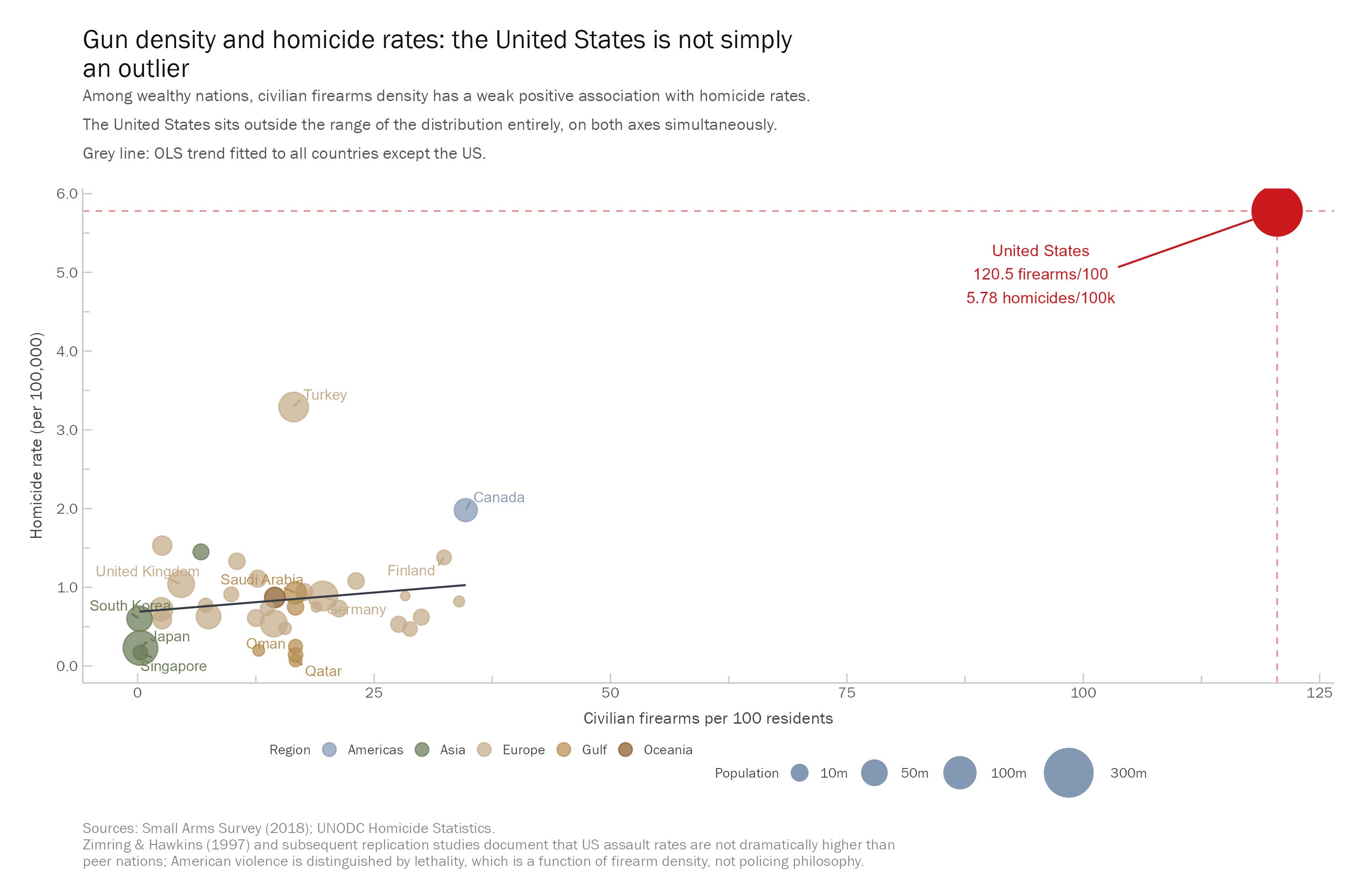
Using murder as the “cleanest” cross-national comparison is reasonable as far as it goes, but Smith treats the resulting fivefold gap as if it demands only a policing/disorder explanation. What he doesn’t engage is that the U.S. murder rate is substantially explained by a single variable that is genuinely exceptional in cross-national terms: gun density. The U.S. has roughly 120 firearms per 100 people; no other wealthy nation is remotely close. The problem is what Smith does not ask about it. A large body of research (Hemenway, Azrael, Miller for example) shows that assault rates in the U.S. are not dramatically higher than peer countries, but that American assaults are far more lethal because they involve firearms. The most comprehensive cross-national study to date, Rutar’s 2025 analysis of over 100 countries using panel methods robust to country-specific heterogeneity finds a consistent, statistically significant, positive relationship between gun ownership and gun homicide rates across every specification tested. A ten percent rise in civilian gun ownership is associated with roughly a three to four and a half percent increase in gun homicide. The same study finds no significant relationship between gun ownership and total homicide rates, which is consistent with partial substitution (where guns are scarce, other weapons are used) but does nothing to diminish the core point: that what distinguishes American violence is not the frequency of conflict but its lethality, and lethality is a function of what people are holding when the conflict occurs. Smith’s prescription of more policing and prosecutorial aggression speaks to neither.
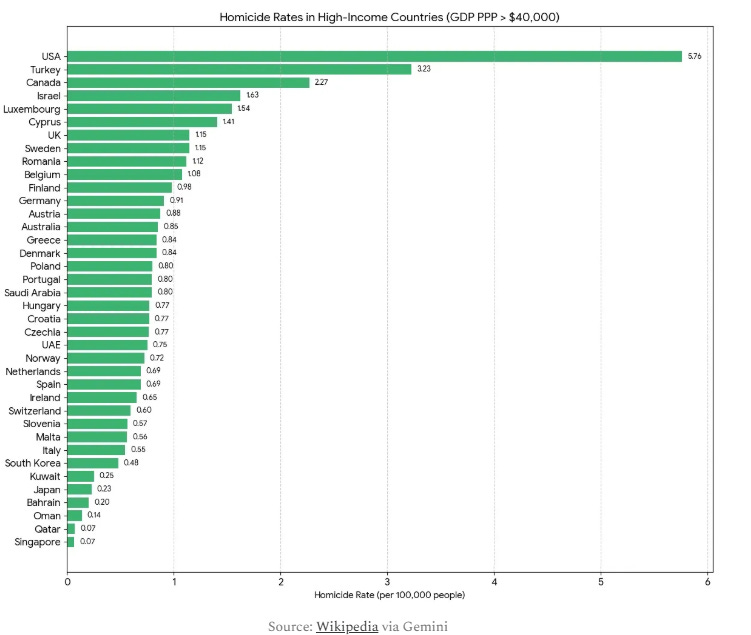
The laziness of the framing, however, is dwarfed by what produced the chart (a hideous creation made in Python using matplotlib by Gemini AI) in the first place. There are multiple fabricated data points against the Wikipedia source Smith cited:
Luxembourg: Smith/Gemini shows 1.54, actual value 0.752 (+105% inflation)
Cyprus: Smith/Gemini shows 1.41, actual value 0.818 (+72%)
Canada: Smith/Gemini shows 2.27, actual value 1.980 (+15%)
Reinhart and Rogoff at least had the dignity of making their error in Excel. They sat down, opened a spreadsheet, and made a human mistake in the traditional way. Smith’s method was to type a question into Gemini, receive a matplotlib plot in return, and publish it as the empirical foundation of his argument, an argument whose entire thrust is that progressives are insufficiently serious about evidence. Smith has written that modern economics represents “academia appropriately tamed,” “hemmed in by guardrails of methodological humility.” The guardrails it seems are continually not consulted before publication.

Beyond that egregious error, the comparison set of countries that Smith compares against because of his focus on “rich” countries is Qatar, UAE, Kuwait, Oman, Bahrain, Saudi Arabia: absolute monarchies with no independent judiciary, large migrant worker populations with severely limited legal recourse, known suppression of crime reporting, and in several cases capital punishment for a broad range of offenses. Singapore is authoritarian city-state with caning, capital punishment, state surveillance, and highly constrained civil society. Smith’s peer nations for America include Qatar, where homosexuality is punishable by imprisonment; Singapore, where the state canes people for vandalism and hangs them for drug offenses; and Saudi Arabia, which was still publicly beheading people for sorcery as recently as 2014. Their homicide rates are, indeed, very low. Smith does not say explicitly that America should become more like Saudi Arabia in order to solve its crime problem, but this is the logical content of the comparison he has chosen to make. He is a careful thinker. He simply did not follow the thought to its conclusion.
The United Nations Office on Drugs and Crime (UNODC) data (which is what Smith’s Gemini-produced chart almost certainly draws from) is a patchwork: some countries report 2021 data, others 2019 or even earlier. This matters enormously because the U.S. had an anomalous homicide spike in 2020-2021 associated with pandemic disruptions, Black Lives Matter movement, pandemic-era institutional disruptions, and firearms purchases. If the U.S. data point reflects 2020-2021 while many European comparators reflect 2018-2019, it’s baked in a cyclical American peak into what’s presented as a structural comparison. Smith even concedes homicides have come down significantly since 2022 but doesn’t reckon with what that does to his analysis.
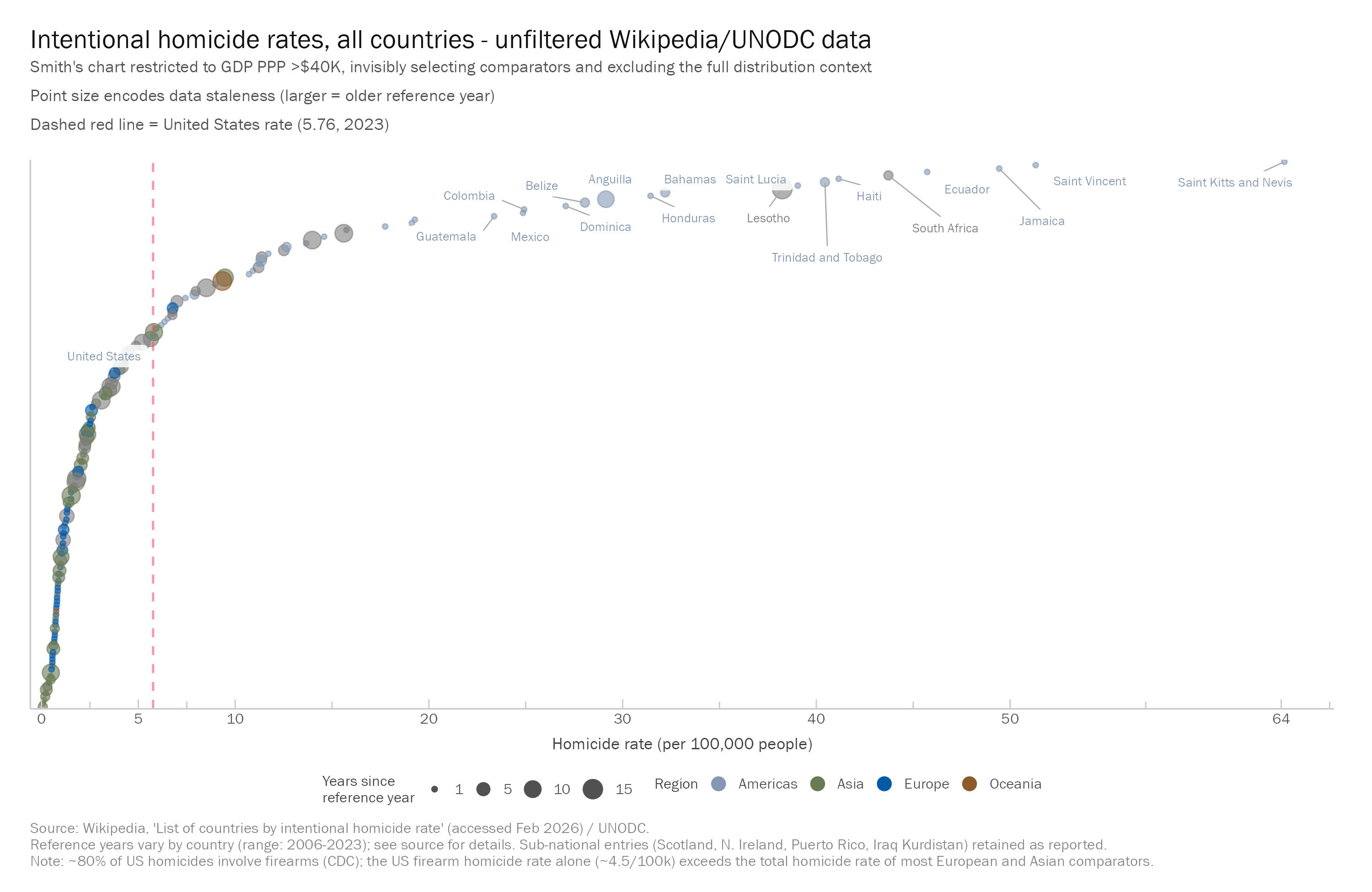
What Smith’s chart also cannot show, and what Smith does not even present to his audience, is that the American homicide rate is overwhelmingly the result of firearm homicides. CDC data places the firearm share of American homicides at roughly 79 to 80 percent. The American firearm homicide rate alone, at approximately 4.5 per 100,000, exceeds the total homicide rate of nearly every country on Smith’s chart. The research literature going back to Zimring and Hawkins in 1997 and confirmed repeatedly since establishes that American assault rates are not dramatically higher than those of peer nations. What distinguishes American violence is its lethality, which is a function of gun density, not of a cultural disposition toward disorder or a political tolerance for criminality. The United States has approximately 120 firearms per 100 residents. No peer nation is even close to the range of that figure. Smith’s social policy, more police, enforced public order, prosecutorial aggression, addresses none of this, because none of it can.
The chart below makes the point more simply than Smith’s preferred methodology allows him to see. It plots civilian firearms per 100 residents against homicide rates across the same nations wealthy enough to appear in his comparison pool, with dot size proportional to population. The grey line is an ordinary least squares trend fitted to every country except the United States. Among peer liberal democracies, the relationship between gun density and homicide is weakly positive and the entire cluster sits below two homicides per 100,000 regardless of where countries fall on the x-axis. The actual American problem falls at the far right edge of the chart, approximately 85 firearms per 100 residents removed from the nearest peer nation, connected to the rest of the plot by a dashed red line because there was no other way to fit it in the same frame.
The problems with the comparison, unfortunately, do not end with the fabricated values. Smith’s inequality paragraph is worth dwelling on because it contains, in compressed form, the method of the entire piece, with its multiple misrepresentations. Smith concedes that America is more unequal than most rich nations, then immediately neutralizes the concession with a citation from the Canadian Fraser Institute establishing that the U.S. fiscal system is more progressive than most of its peers. The Fraser Institute defines progressivity by the steepness of marginal tax rates rather than by redistributive outcome, which is the definition a libertarian think tank would naturally prefer, and which has the additional virtue, from Smith’s perspective, of producing the desired result. By this measure, a country could abolish its welfare state entirely and become more progressive simply by raising its top marginal rate. This tells you something about what the “measure” is actually measuring. It does not appear to tell Smith anything. European social democracies achieve their redistribution not primarily through tax rates but through universal services (single-payer healthcare, universal higher education, subsidized childcare, parental and maternal leave) that do not appear in the Fraser framework because they are delivered as goods rather than cash transfers.

Having established, through this rather creative definition of “progressiveness,” that the U.S. is admirably redistributive, Smith turns to his linked chart of social spending as a share of GDP, which includes Sweden, Germany, Italy, Austria, the UK, Greece, Japan, the Netherlands, Canada, and Australia. He summarizes this chart by noting that the U.S. spends about as much as Canada, the Netherlands, and Australia. Canada, the Netherlands, and Australia are the three countries in the chart that sit closest to the American figure. Sweden at roughly 25 percent of GDP, Germany at 26, Italy and Austria above 27. These countries appear in the chart he links and not in the sentence he writes. The Netherlands comparison carries an additional layer of misdirection: Dutch private social spending, which runs to around 12 percent of GDP, is legally mandatory. Dutch residents are required by law to purchase health insurance through regulated private insurers; occupational pension contributions are compulsory. Comparing American public spending to Dutch public spending while treating the Dutch private component as equivalent to American voluntary employer coverage is not a like-for-like comparison. It is a definitional choice that happens to minimize the gap.
Smith observes, accurately, that Americans spend a lower share of their healthcare costs out of pocket than residents of most peer countries. What this aggregate share conceals is the distribution beneath it. The roughly eight percent of Americans without insurance face list prices that exist precisely because the insurance system inflates them; the much larger population with high-deductible plans faces cost-sharing thresholds that have no equivalent in single-payer systems; and medical debt remains the leading driver of personal bankruptcy in the United States in a way that is simply not true anywhere else in the developed world. None of this appears in a chart of mean out-of-pocket shares. Smith is technically accurate and substantively misleading in the same sentence, which is a refined achievement of misrepresenting facts. The OECD explicitly notes that when you account for private social spending and tax treatment of benefits, the U.S. actually has the highest net total social spending of any OECD country. Smith gestures at this to make the U.S. look generous. But net total social spending includes employer-provided health insurance premiums, 401(k) tax expenditures, and other private arrangements that are voluntary, unequally distributed, and tied to employment. A laid-off worker loses their health insurance; a Danish worker doesn’t. Counting Aetna premiums paid by Amazon on behalf of its employees as equivalent to Sweden’s universal healthcare in a social welfare comparison is an astonishingly senseless take.
The life expectancy gap is handled with similar dexterity. Smith attributes it to obesity and drug overdose, which he characterizes as “diseases of wealth and irresponsibility” rather than failures of policy. Obesity in the United States is concentrated in low-income, food-insecure populations; it is, to the extent that it reflects anything about wealth, a disease of its absence, not its presence. The opioid epidemic was substantially produced by Purdue Pharma’s fraudulent marketing, by FDA regulatory failures, and by the deliberate targeting of deindustrialized communities where alternative forms of relief were scarce. “Diseases of wealth and irresponsibility” is a phrase worth reading slowly for all its smuggery. The populations with the highest obesity rates in America are concentrated in food deserts, in places where a bag of Doritos is cheaper and more available than a vegetable, in communities where the nearest grocery store requires reliable transportation that not everyone has. The opioid epidemic Smith presumably includes here was not a spontaneous outbreak of irresponsibility: it was a fraud scheme, prosecuted in federal court, in which Purdue Pharma falsified clinical data, paid physicians to prescribe, and deliberately targeted the deindustrialized communities least equipped to resist. The responsible parties paid fines and the Sackler family kept their name on museum wings. The irresponsible parties are, in Smith’s formulation, the people who got addicted.
Smith’s policing argument rests on a single paper (Chalfin and McCrary’s 2018 estimate of the marginal productivity of an additional police officer) which Smith presents as settling the question of whether the ACLU is wrong about policing and crime. What Chalfin and McCrary actually estimate is a marginal effect at the intensive margin: given a city’s existing police force, what is the crime-reduction value of one more officer. This is a different question from whether police concentration across cities is causally related to crime rates, which is confounded by the obvious fact that cities with more crime hire more police in response.
Chalfin and McCrary’s central contribution is mostly methodological: it identifies massive measurement errors in the UCR police data and argues that correcting for them increases the estimated police elasticity. The actual empirical conclusion on murder (the crime that drives their entire welfare calculation) is an elasticity of -0.67 with a standard error of plus or minus 0.47. Their estimated confidence interval runs from approximately -1.14 to -0.20. It is very close to zero. The authors themselves describe the quasi-experimental literature as providing “suggestive but not persuasive evidence regarding the effect of police on violent crime.” And yet it is “Very solid evidence,” Smith writes, of a paper whose authors describe their own quasi-experimental literature as “suggestive but not persuasive.” He is following the evidence. The evidence is following him.
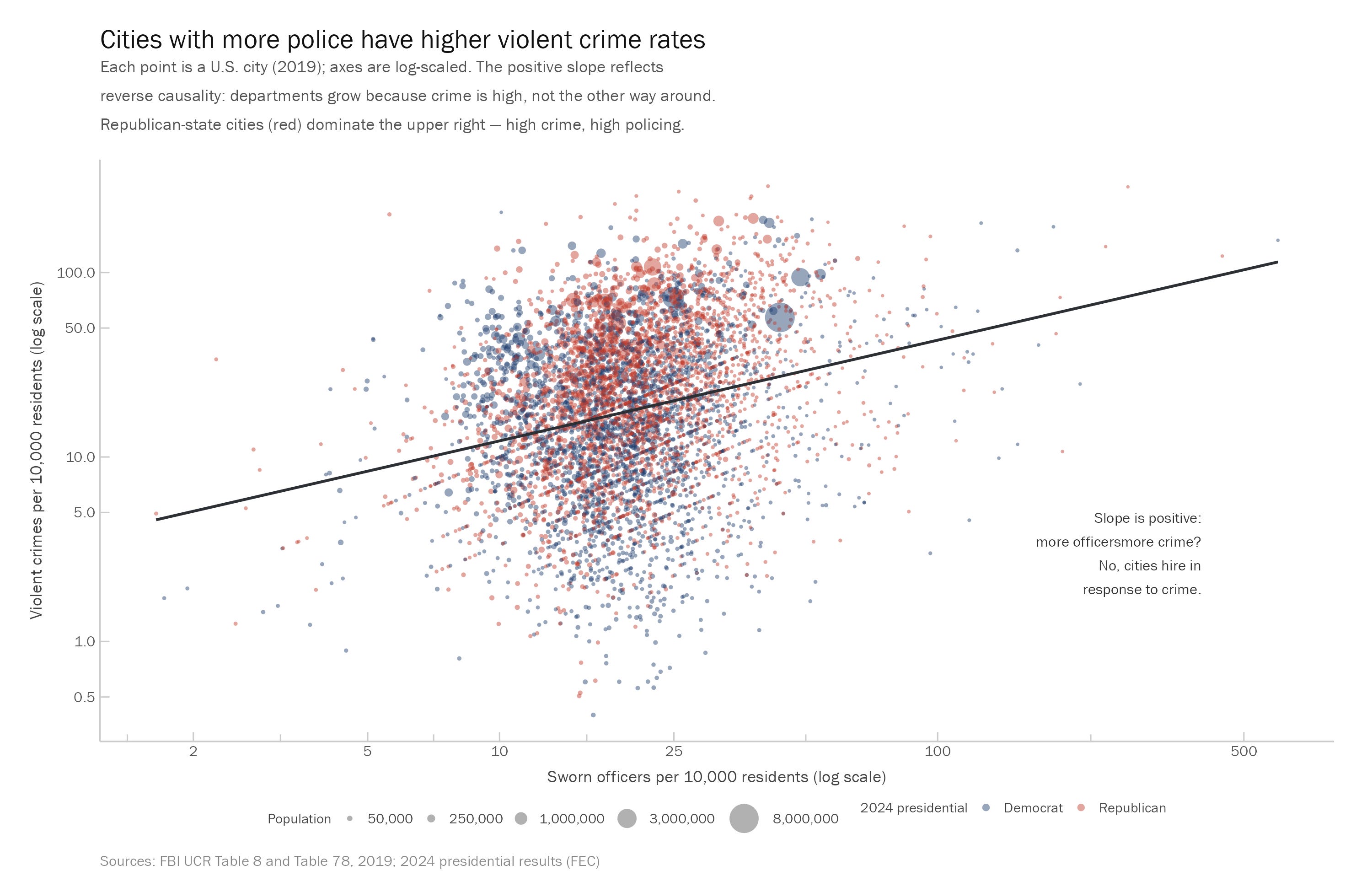
The chart below illustrates the identification problem that Chalfin and McCrary built their entire methodological apparatus to address, and that Smith’s summary of their work quietly drops. The data are drawn from the FBI’s Uniform Crime Reports for 2019 (Table 10 and 78 respectively), plotting sworn officers per 10,000 residents against violent crimes per 10,000 residents for every American city in the dataset, log-scaled on both axes, colored by whether the city sits in a state that voted Republican or Democrat in 2024. Each point is an American city in 2019; the axes are log-scaled; the slope is positive. Cities with more sworn officers per resident have higher violent crime rates. Smith, presumably, would not conclude from this that police cause crime. The slope is positive because the causal arrow runs in the direction any sentient observer would expect: departments grow because crime is high, not the other way around. This is simultaneity bias, and it is the reason a naive cross-sectional regression on police and crime tells you almost nothing about whether hiring more officers reduces violence. It is also, not coincidentally, the reason Chalfin and McCrary’s paper exists.
Cities located in Republican-voting states, where Smith’s general philosophy of public order and prosecutorial seriousness enjoys something closer to political hegemony, average 23.6 sworn officers per 10,000 residents and 33.1 violent crimes per 10,000. Democratic-voting-state cities average 21.8 officers and 23.0 violent crimes. The cities that have most faithfully followed the prescription have the worst outcomes by the prescriber’s own metric. Smith, presumably, would not conclude from this that policing causes crime; and he would be right not to, because the causal arrow runs the other way, which is precisely the point. But it does mean that the cross-sectional data he implicitly relies on to make policing sound like an obvious solution is actually a picture of the problem he claims it solves. It suggests that the cross-sectional relationship between policing and crime is dominated by reverse causality, which is precisely what makes invoking Chalfin and McCrary as “very solid evidence” for Smith’s policy conclusion an act of considerable interpretive audacity.
The welfare calculation that produces the “underpoliced” conclusion in Chalfin and McCrary’s paper is also sensitive to the murder elasticity in a way the paper is explicit about: if police have no effect on violent crime and only affect property crime, the cost-weighted elasticity is a “scant -0.07,” well below the threshold that would justify additional police. The whole conclusion rests on the assumption that the murder elasticity is meaningfully negative, an assumption the paper flags as uncertain in a footnote that Smith, who has read paper carefully, does not mention. Chalfin and McCrary’s footnote 12 flags that the cost-benefit calculation “would not justify the existing number of police” if restricted to property crime effects. The policy prescription that America is underpoliced, that the ACLU is very wrong, that progressive prosecutors are getting people killed: all of it balances on a confidence interval that the authors themselves describe as inconclusive. Smith has built his peroration on a footnote he declined to read. In a paper published a year prior to the 2018 one, Chalfin and McCrary’s abstract states: “Evidence in favor of deterrence effects is mixed.” The review also documents that crime responds to labor market conditions (wages, unemployment, legitimate economic opportunity) as a mechanism equal in importance to policing. Smith does not mention this. The carrots-and-sticks framing in the literature review, where labor market improvements deter crime as effectively as policing, would redirect the entire policy argument toward structural economic conditions rather than doubling down on a policing policy of prosecution. This, of course, disappears entirely from Smith’s account.
Chalfin and McCrary’s literature review also notes that potential offenders frequently do not know when policing policy has changed, that risk perceptions among the general population bear little relationship to actual arrest probabilities, and that deterrence effects are most pronounced among younger offenders early in criminal careers. None of which appears in Smith’s invocation of “very solid evidence.” The evidence is far from it and yet Smith uses it to declare the ACLU “very wrong” about mass incarceration and racialized over-policing which is a claim about the aggregate scale and demographic distribution of criminal justice policy over decades. A measurement-error correction paper studying police elasticities in medium to large U.S. cities between 1960 and 2010 cannot answer that question. The ACLU’s argument, in any case, is not about the sign of a marginal effect. It is about who bears the costs of policing policy and at what scale. This broader social question is not something that a paper on officer productivity cannot answer and is not designed to. Smith uses the one to dismiss the other, which requires treating them as answers to the same question.

The treatment of homelessness and public disorder follows the pattern established everywhere else in the piece. Homeless people commit violent crime at higher rates than the general population, Smith observes, citing an ABC Local television news interactive, an evidentiary standard that, applied consistently, would restructure the social sciences considerably. What the peer-reviewed literature on this population shows (Kushel and colleagues in 2003, Baggett and colleagues in 2013) is that homeless people are disproportionately victims of violent crime rather than its perpetrators. The causal question Smith does not ask is whether unsheltered homelessness produces disorder or whether unsheltered homelessness and disorder share common causes in housing unaffordability, defunded mental health infrastructure, and the gutting of substance use treatment capacity. Smith does not ask it because asking it would require him to treat homelessness as a consequence of something other than “diseases of wealth and irresponsibility,” and consequences imply causes, and causes imply that political and corporate forces, at some point, made decisions that produced the present which is precisely the explanatory territory Smith has cordoned off from the beginning.
This same evasion structures his treatment of suburbanization. Smith cites Cullen and Levitt’s 1999 regression analysis, which he characterizes loosely, as a study of “the effects of changes in the criminal justice system” to establish that crime is a huge driver in Americans’ preference for suburban living. The paper is worth reading carefully, because what it actually shows is more modest and more interesting than Smith’s use of it suggests. Cullen and Levitt study 127 American cities (MSAs to be exact) between 1970 and 1993 and find that a 10% increase in crime corresponds to roughly a 1% decline in city population, with most leavers relocating within the same metropolitan area rather than leaving the region. This is a finding about marginal population adjustments within an already-built suburban landscape, a landscape that federal highway policy, discriminatory mortgage underwriting, and racially restrictive covenants had spent the preceding three decades constructing. Smith also uses the paper to soften the white flight characterization, noting that middle-class Black families fled too. Cullen and Levitt’s own data shows that Black households were in fact less responsive to rising crime than non-Black households, and substantially less likely to leave the metropolitan area entirely. The paper Smith cites to broaden the story beyond race tells a more racially specific story than he acknowledges. Its authors, for their part, cite Wilson’s The Truly Disadvantaged in their introduction. Cullen and Levitt knew what literature they were entering. Smith, having encountered their paper, chose not to follow the citation. Smith then makes the brash claim that America’s urban development pattern is more suburbanized and car-centric than people would like mainly due to crime. Setting aside that this is an extraordinary causal claim to rest on a single paper, it requires ignoring a body of historical and sociological scholarship that runs directly against it. Scholarship that is not obscure, not contested at the margins, and not difficult to locate, or otherwise unavailable to Smith except for a penchant for willful ignorance. Smith has simply chosen not to consult it, which is a choice, and one that turns out to be remarkably convenient for his argument.
Douglas Massey and Nancy Denton’s American Apartheid (1993) documented how hypersegregation (the simultaneous concentration, clustering, centralization, and isolation of Black populations in American cities) was produced by the coordinated operation of racially restrictive covenants, FHA underwriting standards, and real estate industry practices, and how this spatial arrangement interacted with Black poverty to produce the concentrated disadvantage of the inner city. The mechanism Massey and Denton describe does not begin with crime. It begins with the deliberate construction of a geography in which Black families were restricted to a small set of deteriorating neighborhoods while white families were subsidized to leave. William Julius Wilson’s The Truly Disadvantaged traced how deindustrialization then removed the manufacturing employment base from these same neighborhoods, concentrating joblessness in communities already spatially isolated, producing what Wilson called social isolation: the removal of working and middle-class Black residents, the erosion of institutions, and the concentration of the population most vulnerable to economic disruption in precisely the neighborhoods that economic restructuring was devastating. Crime, in Wilson’s account, is one expression of this social isolation, not its cause.
Kevin Fox Gotham’s Race, Real Estate, and Uneven Development uses Kansas City as a case study to show how this process worked at the level of specific institutions and practices: the National Association of Real Estate Boards formalizing appraisal techniques that linked property value to neighborhood racial composition; the FHA adopting HOLC residential security maps that rated Black neighborhoods as hazardous lending risks; blockbusting and panic-selling used to accelerate white departure from transitional neighborhoods; school boundary-drawing used to reinforce racial separation after the covenants were legally voided. Troost Avenue in Kansas City, a north-south thoroughfare that still marks the city’s racial and economic divide, did not acquire its character and reputation because crime made the east side dangerous. It acquired it because the real estate industry and the FHA spent four decades ensuring that Black families could not live anywhere else. To this day, the repercussions of this racially constituted residential segregation pattern persists.
The Interstate Highway Act of 1956, funded by a $25 billion gas tax and administered in part by Francis DuPont, whose family held the largest share of General Motors stock, did not pick and choose at random to place its 40,000 miles of highway. The FHA’s own Underwriting Manual had recommended using highways to separate white and Black communities. Highway construction demolished 37,000 urban housing units per year through the 1960s, disproportionately in Black neighborhoods. As the Columbia University Mailman School of Public Health documented, in the first twenty years of the interstate system, highway construction displaced over one million low-income people of color. Atlanta’s I-20 was designed in a 1960 planning document to serve as “the boundary between the White and Negro communities.” Miami’s I-95 was routed through Overtown, then described as the “Harlem of the South,” reducing a neighborhood of 40,000 to 8,000 residents. James Baldwin’s observation that urban renewal meant “Negro removal” was not rhetorical excess; it was a description of the administrative record, a phrase that appeared in the internal documents of urban renewal agencies themselves.
The automobile industry’s role in this is also documented and not contested. GM President Alfred Sloan established a unit in 1922 charged with replacing streetcar systems with car-dependent alternatives. The GM front company National City Lines, reorganized in 1936 as a holding company, acquired more than 100 streetcar systems in 45 cities and systematically degraded service until ridership collapsed, providing the financial justification for conversion to buses.2 In 1949 GM and its co-conspirators were convicted in federal court of conspiracy to monopolize interstate commerce. The conviction did not restore the streetcar lines. Sloan’s National Highway Users Conference, founded in 1932, became the highway lobby that secured the 1956 National System of Interstate and Defense Highways Act. Charles Wilson, GM’s president, became Eisenhower’s secretary of defense and advocated for the nationwide freeway program on national security grounds—an argument that most certainly would not feel out of place in the current political environment.3 The infrastructure that made the American city car-dependent and the American suburb inevitable was not a market outcome. It was an industry campaign, a federal commitment, and a racial project, operating simultaneously.
Smith’s claim that America’s urban development pattern is mainly due to crime requires that none of this happened, or that it is irrelevant to where Americans live and how they get around, or even more preposterously that it’s the culmination of people making choices. (Smith certainly seems to be holding the latter position).4 The United States is, without exaggeration, Levittown writ large5: a geography produced by the FHA discriminatory practices, the highway system, the racially restrictive covenant, and the deliberate destruction of the transit infrastructure that had made dense urban living viable. William Levitt’s own position was not subtle. He told House and Home magazine in 1954 that he would not sell to Black families, because doing so would cause white families to leave, which would end his market.6 It was the operating principle of the postwar suburban development industry, backstopped by federal mortgage policy and made permanent by highway construction that ensured no alternative geography was available. Crime did not produce all these social maladies: crime is one of the things this produced.
Smith belongs to a specific and well-developed tradition in American liberal thought: the position that presents itself as the view from nowhere. It is the ideology that it is not ideology. The claim is not “I have the right ideology” but “I have transcended ideology by following the evidence.” If you disagree with Smith, you are letting your politics distort your reading of the data. If he reaches a conclusion that sounds like Tucker Carlson, that is simply what the data shows. Smith is a market liberal with a strong prior that existing arrangements are basically efficient; that where people live, what they earn, how healthy they are, reflects something close to equilibrium. Pathologies are disturbances to that equilibrium, introduced by bad actors (criminals, progressive prosecutors, ACLU lawyers, Twitter and Threads leftists) or “bad” ideas. The system itself is not pathological. This is why he cannot ask what caused crime, or what caused suburbanization, or what caused the opioid epidemic. Those questions lead to the system, and the system is the prior he is protecting. This aligns him firmly in the tradition of Gary Becker, although whether Smith recognizes the lineage is doubtful, given his publicly stated conviction that economists have no particular need to read the history of their own discipline. Becker’s project was to extend rational choice theory into domains (crime, family, discrimination) that had previously been understood as social and historical, transforming political questions into optimization problems that could be solved by adjusting incentives rather than changing structures. Smith inherits this framework wholesale, and with it the presuppositions about human nature that render crime as a choice that better policing can make less attractive, suburbanization as a revealed preference, and obesity as irresponsibility. This is not, it should be said, an ideology Smith holds with any particular consistency. Having spent a decade arguing that libertarianism was wrong, he recently apologized, not because his arguments had been refuted, but because Trump’s tariffs turned out to be worse than the free market. “In this world,” he concluded, “there are monsters far more terrifying than the market.” The framework produces whatever conclusion the political moment requires.
Smith ends his post with an update: a paper showing that Republican prosecutors reduce firearm homicide among Black men primarily by securing convictions that legally restrict gun ownership, that is, by reducing gun access, the precise mechanism his entire argument declines to address. He presents this as a challenge to progressives. It is confirmation that the variable he spent several thousand words not discussing is the one that does the work. “Someday soon,” Smith writes, “we should think about getting around to fixing it.”
Burke at least knew he was making a political argument. This is the advantage of writing before economics invented the appearance of not doing so. Gary Becker did more than most to make that appearance available to people who would have been embarrassed to admit what they actually believed. Smith has helpfully unified the tradition.
For the original 1974 Senate testimony that brought these facts to national attention, see Bradford C. Snell, "American Ground Transport: A Proposal for Restructuring the Automobile, Truck, Bus and Rail Industries," presented to the Subcommittee on Antitrust and Monopoly, United States Senate, February 26, 1974.
Wilson is famously misattributed as saying, “What’s good for General Motors is good for the country.” This comes from his confirmation hearing, where Wilson said, “For years I thought that what was good for our country was good for General Motors, and vice versa. The difference did not exist. Our company is too big. It goes with the welfare of the country.”
One hesitates to accuse Noah Smith of a lack of historical consciousness that would rather be like accusing a fish of a lack of interest in mountaineering. It’s simply not the element in which he operates. His method, if one can dignify it with the term, is to declare the past irrelevant while simultaneously treating its most contingent outcomes as eternal forces.
House + Home magazine, December 1952: “The miracle of Levittown, Pa. is that it will be complete in three years. Nothing like it has ever happened before. This is the free enterprise system at its lustiest. The Levitt’s, with considerable justification, believe it is all to the good. In this their newest venture of turning raw land into going communities, they are sure that they are doing the best jobs of their lives” (p. 82).
“The Negroes in America,” Levitt said, “are trying to do in four hundred years what the Jews in the world have not wholly accomplished in six thousand. As a Jew, I have no room in my mind or heart for racial prejudice. But … I have come to know that if we sell one house to a Negro family, then ninety to ninety-five percent of our white customers will not buy into the community. That is their attitude, not ours. ... As a company, our position is simply this: we can solve a housing problem, or we can try to solve a racial problem. But we cannot combine the two.” William Levitt, quoted in Ron Rosenbaum, “The House that Levitt Built,” Esquire, December 1983, 391.

Sorry no. Any serious tackling of US crime issues has to tackle the elephant in the room: https://randomcriticalanalysis.com/2015/06/23/a-county-level-analysis-of-homicide-rates/
and no, it's not 'redlining' or 'white flight' or epigenetic trauma from Emmet Till's death. Grow up.
A more serious analysis can be had here in a review of Stuntz's "Collapse of American Criminal Justice" https://web.archive.org/web/20140304073439/https://handleshaus.wordpress.com/2014/03/03/review-of-the-collapse-of-american-criminal-justice-by-william-j-stuntz/