

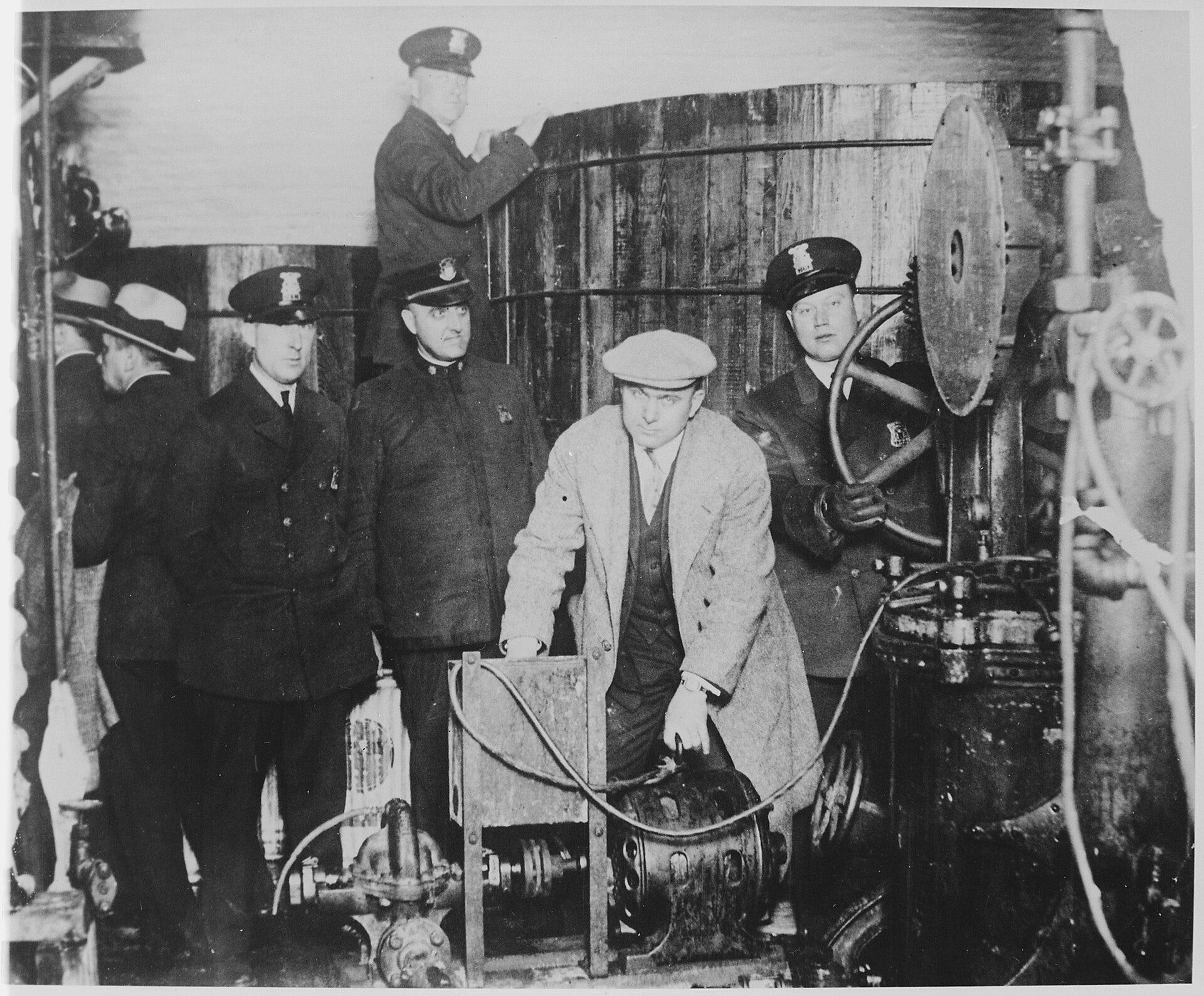
By Heather Michon
On October 28, 1919, Congress did something radical: it banned alcohol. Not just hard liquor, but beer, wine—pretty much anything with alcohol. It was an ambitious social experiments in the United States, and it ultimately failed.
Evan after the Prohibition official began on January 17, 1920, millions of Americans continued to drink. Underground markets supplied illegal bars called speakeasies, while law enforcement struggled to keep up. The country never stopped drinking, it had just changed how it drank.
Although the Prohibition Movement was primarily seen as a campaign against alcohol, it was also an attempt to reshape American society. It sought to impose a new moral order that conformed with middle class standards. It raised questions
And its rise and fall raises a deeper question: how far can a government go in trying to control personal behavior before the system starts to break down?
What was Prohibition?
The Prohibition was a nationwide effort to restrict and ultimately ban the production, sale, and consumption of alcohol in the United States. It grew out of earlier temperance campaigns in the early 19th century, which initially focused on moderation but gradually shifted toward total abstinence.
At its core, the movement was driven by the belief that alcohol was not just a personal vice, but a social problem—one that contributed to poverty, crime, and the breakdown of families. Reformers argued that limiting or eliminating alcohol would lead to a more orderly, moral, and productive society.
Over time, what began as a moral and cultural campaign became a political one. Activists organized, built national networks, and pressured lawmakers to act. Their efforts culminated in the ratification of the 18th Amendment in 1919, which prohibited the manufacture, sale, and transportation of intoxicating liquors. The Volstead Act, passed shortly after, defined what counted as “intoxicating” and established the framework for enforcement.
Prohibition officially began in 1920 and lasted until 1933, when it was repealed by the 21st Amendment. It remains the only time in American history that a constitutional amendment has been overturned by another.
What started as a movement to reform individual behavior ultimately became a national policy experiment—one that revealed both the power and the limits of using law to shape society.
America before Prohibition
In colonial America, alcohol wasn’t just the beverage of choice, it was also seen as healthy. It was seen as safer than water and a way to improve physical health. And a healthy community required healthy people.
If certain people developed a problem with drinking, the community responded with fines or even banishment from their community. Colonial legislatures, meanwhile, tried to manage alcohol by regulating taverns licensing and hours and prohibiting activities like gambling.
This structure began to give way after the American Revolution as the pattern of consumption began to change. With cheap molasses flowing in from the West Indies and surplus grain coming from agricultural expansion, people turned increasingly to hard liquor like rum and whiskey. Distilling became seen as a somewhat seedy business, driven by the desire for high profits.
Temperance Movements
This change in the character of drinking, along with a series of religious revivals, led to the creation of a strong temperance movement in the early 1800s. The American Temperance Society was founded in 1826, and by 1831 had 100,000 members. Anti-drink crusaders spread the message all over the country, with a message about clean living that especially appealed to working-class men who were looking for new models of male behavior in the rapidly industrializing nation. By 1835, an estimated 1.5 million had pledged to abstain from alcohol and other vices.
The movement inevitably led to legislation, as new temperance converts petitioned their representatives to more control over spirituous liquors. Beginning in 1838, several states passed bills regulating the sale and consumption of alcohol; between 1851 and 1855, at least thirteen states passed prohibition laws. All were poorly enforced, and most were repealed by 1865.
Anti-Saloon Activism
The temperance movement revived after the American Civil War. In 1869, several state-level temperance groups joined to form the Prohibition Party. The first convention, held in Washington in September 1869, drew more than 500 activists -- among them women, who were given full rights as delegates. Over the next few years, the Prohibition Party candidates for president and other offices, but never gained power as a third party. However, it did become an important player in the growing Progressive movement and was ahead of its time in the inclusion of women.
Women were among the most prominent players in the postwar movement. Activism focused on saloons and bars, which began in 1873, was almost entirely women-led, with groups staging demonstrations in front of drinking establishments, often for weeks at a time. This led to the creation of the Women’s Christian Temperance Union (WTCU) in 1874, which expanded into the World’s Women’s Christian Temperance Union in 1883. By 1892, they had over 150,000 dues-paying members.
Based in evangelical Christianity, the WTCU wanted to create a “sober and pure world” though the prohibition of all intoxicating liquors. But they also focused on other social issues of the era, including age-of-consent laws, the protection of women, and the “Americanization'' of immigrants.
The Anti-Saloon League, founded in Ohio in 1893, was the first single-issue pressure group. Between 1895 and 1916, 23 of 48 states had passed anti-saloon or prohibition laws. Starting around 1913, the Anti-Saloon League and other groups began to press for national legislation, in the form of a Constitutional amendment to outlaw alcohol in every state in the Union.
Prohibition Becomes Law
Supporters of prohibition, known as “drys,” won a solid two-thirds majority of Congress in the 1916 elections and quickly put an amendment up for debate. It passed on December 17, 1917 by a vote of 282-128 in the House and 47-8 in the Senate. The 21st Amendment was ratified by the required three-fourths of the states on January 16, 1919 and went into effect exactly one year later.
The details of Prohibition were set by the Volstead Act, which was proposed by the Anti-Saloon League and championed by House Judiciary chairman Andrew Volstead of Minnesota. The act defined “liquor” as any beverage containing 0.5% or more of alcohol, which, to the surprise of many effectively, outlawed wine and beer along with hard spirits.
Did Prohibition Work?
The Volstead Act was full of loopholes and contradictions that it would have been hard to enforce, even if there was the manpower to do so. There was never enough funding to put enough inspectors in the field to stem the black market that sprang up to serve the thirsty nation.
People openly flouted the law, sometimes in private “speakeasies,” sometimes in public. For example, Congressman Fiorello La Guardia once called reporters into his office and poured grain alcohol into his non-alcoholic “near beer,” downing the glass right in front of them.
Supporters of Prohibition later pointed to statistics that showed that the death rate among men from cirrhosis of the liver -- a condition caused by long-term alcohol abuse -- dropped from 29.5 per 100,000 in 1911 to 10.7 per 100,000 in 1929. Arrests for public drunkenness dropped 50% during the same period. Critics countered that at least 10,000 people were killed, and many more blinded or injured, from alcohol poisoning caused by unregulated production and homebrewing of “rot-gut” liquor, and there was 24% rise in violent crime caused by warring black-market producers. Ultimately, there was an overall increase in alcohol consumption during the 14 years the amendment was in force.
The End of Prohibition in the United States
The movement for repeal grew to the point where Franklin D. Roosevelt included it as a campaign plank in 1932. Just eight days into his first term, Roosevelt told his advisor “it’s time the country did something about beer.” He sent a short statement to Congress asking for a modification of the Volstead Act to re-legalize the manufacture of beer. “I deem the action at this time to be of the highest importance.” The statement was met by applause on the floor of the House and passed by both chambers in just 30 hours.
With a proposed repeal amendment already under debate in Congress, things proceeded rapidly. The 21st Amendment was sent to the states in April 1933 and was certified on December 5, 1933 after being passed by three-fourths of the states. In a statement after the certification, Roosevelt said:
I trust in the good sense of the American people that they will not bring upon themselves the curse of excessive use of intoxicating liquors to the detriment of health, morals and social integrity. The objective we seek through a national policy is the education of every citizen towards a greater temperance throughout the nation.
Why Prohibition Failed
Prohibition didn’t collapse because Americans suddenly changed their minds about alcohol. It failed because it tried to impose a sweeping moral reform at a national scale without the capacity—or the public consensus—to sustain it.
Three problems made that failure almost inevitable.
Weak Enforcement Capacity
On paper, Prohibition was absolute. In practice, it was barely enforceable.
The federal government never committed the resources needed to police the entire country. There were too few agents, too little funding, and too many ways around the law. Alcohol was easy to produce, transport, and hide. Once legal supply disappeared, illegal networks quickly filled the gap.
This exposed a basic reality: a law is only as strong as the system enforcing it.
Widespread Noncompliance
Prohibition didn’t just face resistance—it faced indifference.
Millions of Americans continued to drink, often openly. Speakeasies operated in cities across the country, and even public officials were known to ignore or mock the law. Drinking never disappeared; it simply moved out of regulated spaces and into private or illicit ones.
When a large share of the population refuses to comply, enforcement becomes less about maintaining order and more about chasing a futile game of catch-up.
The Rise of Black Markets and Unintended Consequences
By banning legal alcohol, Prohibition created a massive economic opportunity for illegal producers and distributors.
Organized crime expanded rapidly, supplying alcohol to a steady and reliable demand. Competition in these illegal markets often turned violent, contributing to rising crime rates. At the same time, the lack of regulation meant that much of the alcohol being consumed was unsafe, leading to poisonings, injuries, and deaths.
In trying to eliminate one set of social problems, Prohibition helped create another.
A Policy That Undermined Itself
Prohibition reduced some visible harms, like public drunkenness, but it replaced them with less visible—and often more dangerous—ones. More importantly, it revealed a deeper limitation: laws that lack broad support and realistic enforcement mechanisms tend to erode over time.
By the early 1930s, the gap between law and everyday behavior had become impossible to ignore. What began as a confident attempt to reshape society ended as a demonstration of how difficult it is to regulate personal behavior on a national scale.
Timeline of Prohibition in the United States
1600s–1700s: Alcohol widely consumed in colonial America; considered safer than water and socially acceptable
Late 1700s: Taverns central to political and social life
Early 1800s: Per capita alcohol consumption rises sharply—especially hard liquor
1826: American Temperance Society founded
1830s: Rapid expansion of temperance organizations across the U.S.
1831: ~100,000 members in the Temperance Society
1835: ~1.5 million Americans pledge abstinence
1840: Washingtonian Movement promotes personal reform and sobriety
1851: Maine passes the first statewide prohibition law (“Maine Law”)
1850s: At least 13 states adopt prohibition laws
1860s: Most of these laws are repealed or ignored
1869: Prohibition Party founded (first national political effort)
1873–1874: Women-led anti-saloon protests spread
1874: Women’s Christian Temperance Union (WCTU) founded
1880s: WCTU expands into national and international organization
1893: Anti-Saloon League founded in Ohio
Late 1890s–1910s: League becomes dominant political force behind prohibition
1900–1910: Carrie Nation conducts a crusade smashing saloons.
1900–1915: Increasing number of counties and states go “dry”
1913: The Interstate Liquor Act prohibits shipping alcohol into "dry" states
1917: 18th Amendment passes Congress
1919 (Jan 16): 18th Amendment ratified by the states
1919 (Oct): Volstead Act passed, defining enforcement
1920 (Jan 17): Prohibition officially begins
Early 1920s: Speakeasies spread in major cities
1920s: Bootlegging and organized crime expand rapidly
Mid–late 1920s: Public defiance becomes widespread
1929: Elliot Ness begins tackling organized crime in Chicago; St. Valentine's Day Massacre occurs. Stock market crash fuels the desire to repeal Prohibition and gain tax revenue.
Early 1930s: Support for Prohibition declines sharply
1932: Franklin D. Roosevelt campaigns on repeal
1933 (March): Beer legalized again through modification of Volstead Act
1933 (Dec 5): 21st Amendment ratified, repealing Prohibition
Q&A
What is Prohibition?
Prohibition was a nationwide ban on the production, sale, and transportation of alcohol in the United States. Enforced through the 18th Amendment and the Volstead Act, it aimed to reduce crime and improve morality—but instead fueled illegal markets, corruption, and organized crime networks across the country.
When did Prohibition start?
Prohibition officially began on January 17, 1920, when the 18th Amendment went into effect. Congress had passed the Volstead Act in 1919 to define and enforce the ban, setting the stage for a nationwide experiment in regulating morality through federal law.
Why was the 18th Amendment passed?
The 18th Amendment was passed due to decades of activism by temperance groups like the Women’s Christian Temperance Union and the Anti-Saloon League. Supporters linked alcohol to poverty, crime, and domestic violence, believing prohibition would strengthen families, improve worker productivity, and promote a more disciplined society.
How long did Prohibition last?
Prohibition lasted from 1920 until 1933, a period of thirteen years. It ended with the ratification of the 21st Amendment, which repealed the 18th Amendment. The policy’s relatively short lifespan reflected growing public dissatisfaction and the practical challenges of enforcing such a sweeping national ban.
Who supported Prohibition?
Support for Prohibition came from religious groups, reformers, and rural Americans. Organizations like the Women’s Christian Temperance Union and Anti-Saloon League led the charge. Many Protestants, progressives, and middle-class citizens believed banning alcohol would reduce social problems and create a more orderly, moral nation.
Did Prohibition work?
Prohibition partly reduced legal alcohol consumption but failed overall. Illegal production and distribution flourished, organized crime expanded, and enforcement proved inconsistent. Figures like Al Capone built empires supplying illicit liquor. Instead of eliminating alcohol-related problems, Prohibition shifted them into underground economies that proved difficult to control.
What is a speakeasy bar? Why is it called a speakeasy?
A speakeasy was an illegal bar that sold alcohol during Prohibition. The term came from patrons being told to “speak easy,” or quietly, to avoid attracting police attention. These hidden establishments operated behind secret doors or passwords, becoming central social spaces despite the nationwide ban on alcohol.
What kind of music was played in speakeasies?
Speakeasies were hubs for Jazz, which became the soundtrack of the 1920s. Live bands played energetic, improvisational music associated with the Jazz Age. Artists like Louis Armstrong helped popularize the genre in these underground venues.
What was Prohibition?
Prohibition was a national policy banning alcohol, enforced through the 18th Amendment and Volstead Act. It reflected reformers’ hopes to curb vice and social disorder but instead generated widespread illegal activity, reshaping American law enforcement and public attitudes toward government regulation.
Why did Prohibition fail?
Prohibition failed because it tried to regulate behavior that millions refused to abandon. Enforcement was underfunded and inconsistent, corruption spread, and criminal networks thrived. The law lacked broad public support, especially in cities, making compliance unrealistic and turning ordinary citizens into routine violators of federal law.
Why was Prohibition repealed?
Prohibition was repealed in 1933 with the 21st Amendment due to widespread noncompliance, rising crime, and lost tax revenue during the Great Depression. Legalizing alcohol promised jobs, government income, and a way to dismantle the powerful illegal liquor economy.
How did Prohibition affect the nation?
Prohibition reshaped American society by expanding federal power, encouraging organized crime, and altering social norms. It fueled illegal markets, normalized lawbreaking for many citizens, and boosted industries like nightlife and jazz culture. Its failure also made Americans more skeptical of sweeping moral legislation imposed through federal authority.
Further Reading:
Lisa McGirr, The War on Alcohol: Prohibition and the Rise of the American State. United Kingdom, W. W. Norton, 2015.
Prohibition has long been portrayed as a “noble experiment” that failed, a newsreel story of glamorous gangsters, flappers, and speakeasies. Now at last Lisa McGirr dismantles this cherished myth to reveal a much more significant history. Prohibition was the seedbed for a pivotal expansion of the federal government, the genesis of our contemporary penal state. Her deeply researched, eye-opening account uncovers patterns of enforcement still familiar today: the war on alcohol was waged disproportionately in African American, immigrant, and poor white communities. Alongside Jim Crow and other discriminatory laws, Prohibition brought coercion into everyday life and even into private homes. Its targets coalesced into an electoral base of urban, working-class voters that propelled FDR to the White House.
This outstanding history also reveals a new genome for the activist American state, one that shows the DNA of the right as well as the left. It was Herbert Hoover who built the extensive penal apparatus used by the federal government to combat the crime spawned by Prohibition. The subsequent federal wars on crime, on drugs, and on terror all display the inheritances of the war on alcohol. McGirr shows the powerful American state to be a bipartisan creation, a legacy not only of the New Deal and the Great Society but also of Prohibition and its progeny.
The War on Alcohol is history at its best―original, authoritative, and illuminating of our past and its continuing presence today.
Edward Behr, Prohibition: Thirteen Years That Changed America. United States, Arcade, 2011.
From the bestselling author of The Last Emperor comes this rip-roaring history of the government’s attempt to end America’s love affair with liquor—which failed miserably. On January 16, 1920, America went dry. For the next thirteen years, the Eighteenth Amendment prohibited the making, selling, or transportation of “intoxicating liquors,” heralding a new era of crime and corruption on all levels of society. Instead of eliminating alcohol, Prohibition spurred more drinking than ever before.
Formerly law-abiding citizens brewed moonshine, became rum- runners, and frequented speakeasies. Druggists, who could dispense “medicinal quantities” of alcohol, found their customer base exploding overnight. So many people from all walks of life defied the ban that Will Rogers famously quipped, “Prohibition is better than no liquor at all.” Here is the full, rollicking story of those tumultuous days, from the flappers of the Jazz Age and the “beautiful and the damned” who drank their lives away in smoky speakeasies to bootlegging gangsters—Pretty Boy Floyd, Bonnie and Clyde, Al Capone—and the notorious St. Valentine’s Day Massacre. Edward Behr paints a portrait of an era that changed the country forever.
Daniel Okrent, Last Call: The Rise and Fall of Prohibition. United Kingdom, Scribner, 2010.
From its start, America has been awash in drink. The sailing vessel that brought John Winthrop to the shores of the New World in 1630 carried more beer than water. By the 1820s, liquor flowed so plentifully it was cheaper than tea. That Americans would ever agree to relinquish their booze was as improbable as it was astonishing.
Yet we did, and Last Call is Daniel Okrent’s dazzling explanation of why we did it, what life under Prohibition was like, and how such an unprecedented degree of government interference in the private lives of Americans changed the country forever.
Writing with both wit and historical acuity, Okrent reveals how Prohibition marked a confluence of diverse forces: the growing political power of the women’s suffrage movement, which allied itself with the antiliquor campaign; the fear of small-town, native-stock Protestants that they were losing control of their country to the immigrants of the large cities; the anti-German sentiment stoked by World War I; and a variety of other unlikely factors, ranging from the rise of the automobile to the advent of the income tax.
Through it all, Americans kept drinking, going to remarkably creative lengths to smuggle, sell, conceal, and convivially (and sometimes fatally) imbibe their favorite intoxicants. Last Call is peopled with vivid characters of an astonishing variety: Susan B. Anthony and Billy Sunday, William Jennings Bryan and bootlegger Sam Bronfman, Pierre S. du Pont and H. L. Mencken, Meyer Lansky and the incredible—if long-forgotten—federal official Mabel Walker Willebrandt, who throughout the twenties was the most powerful woman in the country. (Perhaps most surprising of all is Okrent’s account of Joseph P. Kennedy’s legendary, and long-misunderstood, role in the liquor business.)
It’s a book rich with stories from nearly all parts of the country. Okrent’s narrative runs through smoky Manhattan speakeasies, where relations between the sexes were changed forever; California vineyards busily producing “sacramental” wine; New England fishing communities that gave up fishing for the more lucrative rum-running business; and in Washington, the halls of Congress itself, where politicians who had voted for Prohibition drank openly and without apology.
Last Call is capacious, meticulous, and thrillingly told. It stands as the most complete history of Prohibition ever written and confirms Daniel Okrent’s rank as a major American writer.
Kenneth D. Rose, American Women and the Repeal of Prohibition. United States, NYU Press, 1997.
In 1933 Americans did something they had never done before: they voted to repeal an amendment to the U.S. Constitution. The Eighteenth Amendment, which for 13 years had prohibited the manufacture and sale of alcoholic beverages, was nullified by the passage of another amendment, the Twenty-First. Many factors helped create this remarkable turn of events. One factor that was essential, Kenneth D. Rose here argues, was the presence of a large number of well-organized women promoting repeal.
Even more remarkable than the appearance of these women on the political scene was the approach they took to the politics of repeal. Intriguingly, the arguments employed by repeal women and by prohibition women were often mirror images of each other, even though the women on the two sides of the issue pursued diametrically opposed political agendas. Rose contends that a distinguishing feature of the women's repeal movement was an argument for home protection, a social feminist ideology that women repealists shared with the prohibitionist women of the Women's Christian Temperance Union. The book surveys the women's movement to repeal national prohibition and places it within the contexts of women's temperance activity, women's political activity during the 1920s, and the campaign for repeal.
While recent years have seen much-needed attention devoted to the recovery of women's history, conservative women have too often been overlooked, deliberately ignored, or written off as unworthy of scrutiny. With American Women and the Repeal of Prohibition, Kenneth Rose fleshes out a crucial chapter in the history of American women and culture.