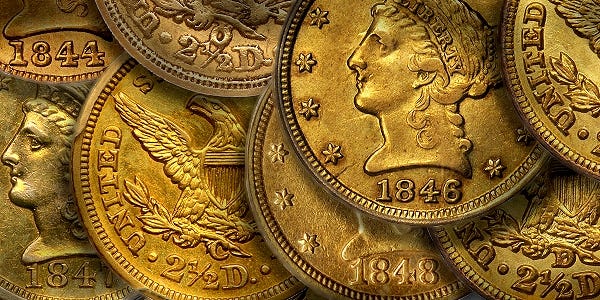
The Authority of Gold
Money, Empire, and the Power to Define Value
After the gun smoke cleared from Baja California, ending the last skirmish of the Mexican American War, Edward Gould Buffum went searching for gold. Traveling north through Sutter’s Fort, the soldier turned prospector reached Weaver’s Creek, where he found a new army of men who traded guns for shovels and went to war with the earth. While Buffum was eager to find his fortune, he was equally absorbed in the novelty of the adventure. A former journalist, Buffum documented his travels like a detective searching for something strange. What he found, though, was more puzzling than he ever imagined. It wasn’t the rugged landscape or the frenzy for hidden treasure; it was the Indigenous people, who threw gold into rivers or scattered its dust into the wind. “When the gold was first discovered,” he later wrote of his encounter, they “had very little conception of its value, and would readily exchange handfuls of it for any article of food they might desire, or any old garment gaudy enough to tickle their fancy.”1
Like many other travelers who collided with different people and cultures in California in the 1850s, Buffum turned a sideways eye to this curious indifference to gold. It wasn’t just puzzling; it was an unnerving challenge to his worldview. And in this epistemic borderland, where the meaning of value came unhinged, men like Buffum joined a growing chorus of observers who sought to restore order. While these efforts to counter any ‘irrational’ challenge with ‘civilized’ certainty cast an imperial shadow over California in the mid-nineteenth century, it would eventually stretch far beyond the goldfields.
In the late 1860s, for instance, when national debates over the money forged new kinds of factions, the shadow resurfaced. No longer aimed at ‘uplifting’ Indigenous people, the self-styled civilizers shifted their gaze—toward a restless crowd of farmers and workers who were beginning to find their collective voice. To these working-class Americans, gold was a medium of exchange, a store of value, and a unit of account. Once minted, it was money—nothing more, nothing less. But to the old money men—the urban elites who understood the ‘natural’ path of civilization—gold wasn’t just valuable, it defined value itself. Some described it as the “divinely ordained” standard of value, while others saw it as the product of “natural law.” It was all scientific, as the era’s economists would say.
Even beyond these attributes, economic historians describe how “Victorian and Edwardian virtues of thrift, reliability, stability and cosmopolitanism were invoked ritually as attributes of the monetary system.”2 Seen in this light, the gold standard wasn’t just a monetary mechanism—it was also a kind of moral system that symbolized social and economic stability. It reflected the natural order. And in a world that grew more interconnected and unpredictable, this collective faith in the golden calf calcified into something so natural and divine that it may as well have been written in the stars. From this view, the demand for unbacked greenbacks in the 1860s and 1870s, or the growing calls for “free silver” in the 1890s, seemed heretical. In the words of David Wells, one of the era’s leading economists, it was “warfare against the beneficence of the Almighty.”3
The “money question,” as this debate was known, has long captivated both economists and historians.4 Some see it as a moment of political and economic transformation, while others see it as a window into the cultural politics of value. It was a rare moment, as Kathryn Morse explains, when unstated assumptions about gold climbed to the surface—revealing how people make choices about which natural resources to value.5 And as questions about money and value emerged alongside debates over race, citizenship, and immigration, Michael O’Malley shows how Americans began using similar terms, analogies, and assumptions to articulate the ‘intrinsic’ value of gold and whiteness. Monetary metaphors trickled into narratives of race, while assumptions about racial hierarchy and evolutionary progress steered new stories about money. This narrative synergy didn’t just expand the range of ways to articulate the ‘natural’ order, it amplified their collective power.6
While these historians have opened our field of vision, creating new ways of understanding this familiar debate, they have also blurred questions about value and the standard of value. Instead of analyzing the cultural and political weight of the gold standard, which they do implicitly, they focus more on intrinsic value. Asking how people constructed an image of gold as intrinsically valuable, though, is different from how they constructed an image of it as the natural benchmark of value itself. Few questioned whether silver was intrinsically valuable, so the real issue wasn’t over which metal was inherently valuable. The more fundamental conflict centered around the meaning of value and who or what could define it. Could the government construct its own kind of value system, or was gold the natural benchmark of value?
To understand the transformation of gold from a valuable object to an object that defines value, it’s useful to begin with the history of a coin: the British guinea, named after the Guinea Coast of Africa. These gold coins were worth twenty silver shillings around the turn of the eighteenth century; but in 1717, Isaac Newton, then Master of the Royal Mint, decided they should be worth twenty-one shillings instead. It was a deceptively small shift that changed the world. By devaluing silver in Britain, many people just decided to take their silver coins to France or Holland, where they could still get a guinea worth of gold for twenty shillings. As silver became scarce in the island, Britain was forced onto a de facto gold standard. Members of Parliament began to formalize the system in 1816, but these efforts led to a series of debates that became known as the “Bullion Controversy.”7
This was the first modern “money question,” a political moment that inspired poets like Percy Shelley to speak out against what he saw as financial oppression. “‘Tis to let the Ghost of Gold,” he wrote in The Mask of Anarchy, “Take from the Toil a Thousandfold, More than e’er its substance could, In the tyrannies of old.”8 In the House of Commons, meanwhile, men like Charles Callis Western called attention to the religious zeal that took hold in the gold crowd. “A degree of something like superstitious veneration,” he announced in 1822, “has been created for what they called a sound metallic currency at the ancient standard of value.”9 Political economists like David Ricardo, meanwhile, supplied the intellectual grammar of the system. “Among economists from the 1820’s on,” as the American economist Frank Fetter once wrote, “the gold standard was a matter of economic theology rather than economic analysis.”10 And as Britain expanded its territorial, economic, and intellectual empire—becoming a model of modernity—many people began attributing this triumph to the gold standard.
This confluence of ideas, industry, and empire set gold in motion, but it wasn’t until after the global gold rushes of the mid-nineteenth century that a new kind of international system began to take form. Economic historians usually offer a few passing remarks on how the global supply of gold increased in this era, but they don’t typically give the gold rushes a prominent role in their narratives about the gold standard. And histories of the gold rush, meanwhile, are also siloed off from monetary history. “They have little to say to each other,” as Mae Ngai explains, “like ships passing in the night.”11 Building on Marilyn Lake’s and Henry Reynolds’s work that reveals how an “imagined white community” emerged in this era, Ngai examines how the gold rushes ushered in a new era of empire and racial capitalism that united the “Anglo-world” through whiteness and gold.12
In this new world that “gold spun,” Ngai argues, the international gold standard became possible. Seen in this light, the rise of the international gold standard was neither natural nor divine—it was the product of power.13 Over the following decades, when economically advanced nations began to demonetize silver and gravitate toward gold, the global price of silver began a steady decline. Ngai reveals how this weakened the economic positions of nations who remained on the silver standard, but it also destabilized nations who remained on the bimetallic system. In this context, monetary stability became a geopolitical problem that required international coordination. France led an effort to stabilize the ratio between gold and silver by forming the Latin Monetary Union in 1865, and several European nations joined. But bimetallism remained an unstable.
With Britain on gold, and German and U.S. leaders eyeing a similar path, the French government invited some of the leading powers to an international monetary conference. It was the summer of 1867—during the Exposition Universelle—when delegates from the United States and several European nations met in Paris. The conference didn’t materialize in any formal commitments, but economic historians often see this as a point of origin, when a new international consensus emerged. Men like Ernest Seyd, the attending British economist, began describing how “civilized nations” used gold while “uncivilized nations” used silver.14 As other national delegates joined the chorus, a new “ideology of gold” began to take hold. Political scientist Guilio Gallarotti describes this ideology as one of the “structural foundation[s] of the gold standard,” while Barry Eichengreen and Peter Temin show how this golden creed evolved into an intellectual cage that would eventually have catastrophic consequences.15
E. Gould Buffum, Six Months in the Gold Mines: From a Journal of Three Years Residence in Upper and Lower California, 1847–49 (Philadelphia, 1850), 93.
Barry Eichengreen and Peter Temin, “The Gold Standard and the Great Depression,” NBER Working Paper Series, no. 6060 (Cambridge, Mass.: National Bureau of Economic Research, June 1997), 3.
David A. Wells, The Silver Question: The Dollar of the Fathers versus the Dollar of the Sons (New York, 1877), 37
For histories of “money question” in this era, see James Livingston, Origins of the Federal Reserve System: Money, Class, and Corporate Capitalism, 1890–1913 (Ithaca, 1986); Gretchen Ritter, Goldbugs and Greenbacks: The Antimonopoly Tradition and the Politics of American Finance in America, 1865–1896 (New York, 1997); and Wyatt Wells, “Rhetoric of the Standards: The Debate Over Gold and Silver in the 1890s,” Journal of the Gilded Age and Progressive Era, 14 (Jan. 2015), 49–68. For histories that situate the “money question” in an imperial context, see Emily S. Rosenberg’s Financial Missionaries to the World: The Culture and Politics of Dollar Diplomacy (Durham, 2003); G. Balachandran, “Power and Markets in Global Finance: The Gold Standard, 1890–1926,” Journal of Global History, 3 (2018), 313–35; and Alan E. S. Lumba, Monetary Authorities: Capitalism and Decolonization in the American Colonial Philippines (Durham, 2022), 42.
Kathryn Morse, The Nature of Gold: An Environmental History of the Klondike Gold Rush (Seattle, 2009).
Michael O’Malley, “Specie and Species: Race and the Money Question in Nineteenth-Century America,” American Historical Review 99, no. 2 (April 1994): 369–395; and Michael O’Malley, Face Value: The Entwined Histories of Money and Race in America (Chicago, 2012).
On the cultural significance of the “bullion controversy,” see Timothy Alborn, All That Glittered: Britain’s Most Precious Metal from Adam Smith to the Gold Rush (New York: Oxford University Press), 162. For the full sweep of humanities relationship with gold that goes back to the ancient world, see Peter L. Bernstein, The Power of Gold: The History of an Obsession (2000; New York, 2012).
Percy Bysshe Shelley, The Masque of Anarchy: A Poem (London, 1832), 23, https://ia600201.us.archive.org/9/items/masqueofanarchyp00shel/masqueofanarchyp00shel.pdf. It was originally written in 1819 after a massacre in Manchester.
Charles Callis Western, Second Address to the Landowners of the United Empire, 1822, p. 23, https://www.biodiversitylibrary.org/bibliography/102985.
Frank Fetter, Development of British Monetary Orthodoxy, 1897-1875 (Cambridge, Mass., 1965), 41.
Mae Ngai, The Chinese Question: The Gold Rushes and Global Politics (New York, 2021), 5.
Marilyn Lake and Henry Reynolds, Drawing the Global Colour Line: White Men’s Countries and the International Challenge of Racial Equality (New York, 2008).
Ngai, The Chinese Question, 15 and 283.
U.S. Congress, Senate, 1879, International Monetary Conference, vols. I and II, 44 Cong. 2 sess, p. 11, cited in Ibid., 145.
Guilio M. Gallarotti, The Anatomy of an International Gold Standard (New York, 1995), 144; and Barry Eichengreen and Peter Temin, “The Gold Standard and the Great Depression,” Contemporary European History, 9 (July 2000), 183–207.


The distinction between gold as "valuable" versus gold as "defining value" cuts to something essential about monetary authority. When Eichengreen and Temin describe the gold ideology as an intellectual cage, they're pointing to how institutional path dependencies can override pragmatic adjustment. The contemporary parallel is striking—today's debates around Bitcoin's "digital gold" narrative echo these same tensions between constructed standards and inherent value, suggesting that the question of who defines value remains as contested as ever.
Excellent piece with a wide run over history and specific details on the stops. Can you clarify footnote 1, which simply shows the text of the next paragraph? Thanks again for this Economic Historian.